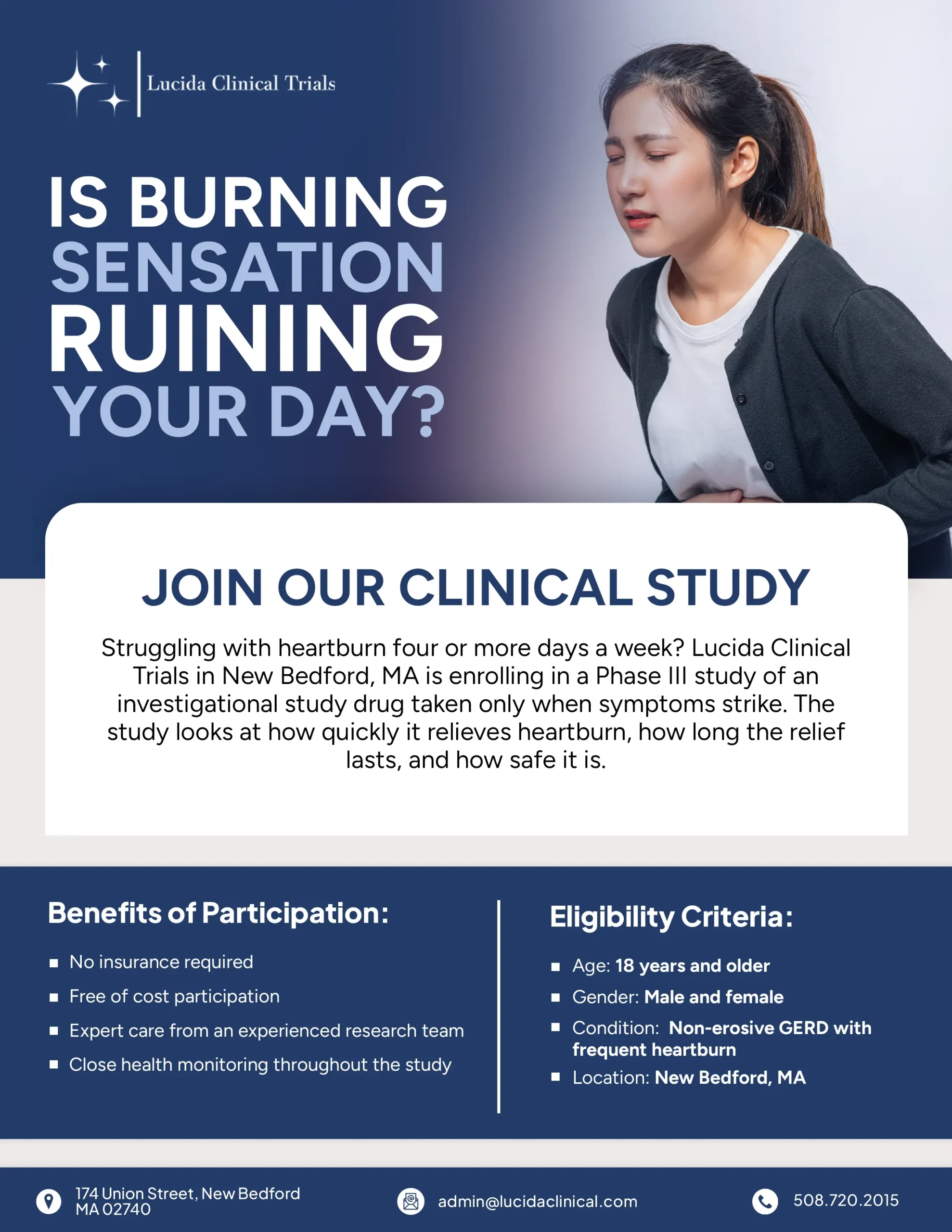
Gastroesophageal reflux disease (GERD) happens when stomach acid flows back up into the esophagus, the tube that connects your throat to your stomach. The result is a burning feeling in the chest, often after meals, at night, or without warning. In non-erosive GERD, people have these symptoms without visible damage to the esophagus on an endoscopy exam.
Standard GERD care often includes acid-reducing medicine taken daily. That raises a fair research question: do people whose heartburn comes, and goes need treatment every day, or could it be taken only when symptoms occur? This study is designed to help answer it. Please keep taking any medicine your doctor has prescribed and talk with your doctor before changing it.
Get emergency help for chest pain with shortness of breath, sweating, or pain spreading to your arm or jaw. See a doctor promptly if you have trouble swallowing, unexplained weight loss, vomiting blood, or black stools.
How Clinical Trials Can Help
Clinical trials are how researchers learn whether an investigational medicine is safe and effective. At our New Bedford site, participants in this GERD study receive close monitoring from an experienced research team while helping researchers learn how well the study drug works, how safe it is, and how it fits into daily life. The study drug may not relieve your heartburn, and you may be assigned to a placebo.