

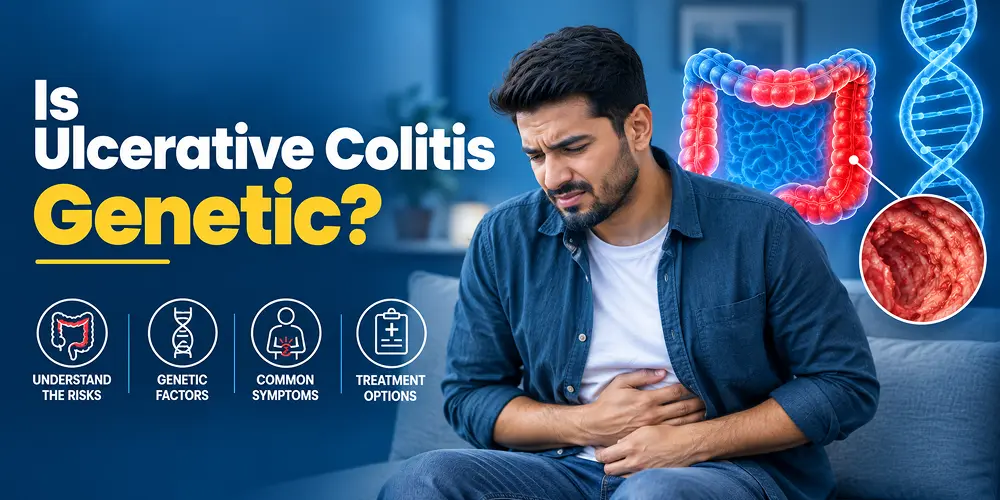
Key Takeaways
- Ulcerative colitis (UC) can run in families, but it does not follow a simple inheritance pattern.
- Having a parent, sibling, or child with inflammatory bowel disease (IBD) increases your risk but does not mean you will develop UC.
- Hundreds of genetic factors have been linked to IBD susceptibility, but no single gene determines whether someone will develop UC.
- Family history is one piece of the risk picture, alongside immune, microbiome, and environmental factors.
- If you have persistent digestive symptoms and a family history of IBD, talking with a healthcare professional can help determine whether further evaluation is needed.
If you have ulcerative colitis (UC), you may wonder whether your children or other family members could develop it too. Or perhaps someone in your family has UC, and you are worried about your own risk.
The answer to the question, “Is ulcerative colitis genetic?” is not as simple as “yes” or “no.”
Ulcerative colitis has a genetic component, but it is not caused by one single gene. Having a close relative with inflammatory bowel disease (IBD) can increase your risk, but many people with UC have no family history of the condition.
Genes are only one part of the picture. Immune system activity, the gut microbiome, and environmental factors may also influence whether someone develops UC.
Quick Answer
Yes, ulcerative colitis has a genetic component, but it is not a strictly inherited disease. Certain genetic variations can make someone more susceptible to developing ulcerative colitis (UC), and having a close family member with inflammatory bowel disease (IBD) can increase risk. However, genes alone do not determine whether someone will develop UC. Researchers believe the condition results from a combination of genetic susceptibility, immune system responses, the gut microbiome, and environmental factors.
Before we get into the role of genetics, let’s take a quick look at what ulcerative colitis is and what it does to the body.
What Is Ulcerative Colitis?
Ulcerative colitis (UC) is a chronic inflammatory bowel disease (IBD) that affects the colon and rectum. It causes inflammation and ulcers in the inner lining of the large intestine.
This inflammation can interfere with the colon’s normal function and lead to symptoms such as diarrhoea, rectal bleeding, abdominal pain, and an urgent need to have a bowel movement. Symptoms can range from mild to severe.
UC is also a relapsing and remitting condition. This means symptoms may become active during a flare and then improve or disappear during periods of remission.
But what causes this inflammation in the first place? That is where genetics, the immune system, the gut microbiome, and environmental factors come into the picture.

Is Ulcerative Colitis Genetic, Hereditary, or Inherited?
These terms are often used interchangeably, but they do not mean exactly the same thing.
How Genetics May Influence Ulcerative Colitis?
Research has identified hundreds of genetic factors associated with IBD. Some of these may affect immune responses or the intestinal barrier, making certain people more susceptible to abnormal inflammation.
This is why it is accurate to say that ulcerative colitis has a genetic component.
However, having genetic susceptibility does not mean someone will definitely develop UC. Researchers currently understand IBD as a complex disease involving interactions between genes, the immune system, the microbiome, and environmental factors.
Is Ulcerative Colitis Hereditary or Inherited?
Ulcerative colitis can run in families, but it is not inherited in a simple, predictable way.
In other words, you do not inherit UC from a parent in the same straightforward manner as some single-gene conditions.
A more accurate way to think about it is that a person can inherit susceptibility to IBD. Other biological and environmental factors may then influence whether the disease develops.
Ulcerative Colitis and Family History: What Does It Mean for Your Risk?
Having a family history of IBD is an important risk factor for ulcerative colitis. NIDDK notes that UC is more likely to occur in people with a first-degree relative, such as a parent, sibling, or child, who has IBD.
A large systematic review and meta-analysis of 71 studies involving 86,824 people with UC found that 12% had a family history of IBD. A family history of UC was more common than a family history of Crohn’s disease among these patients.
This statistic is important for context: most people with UC in that analysis did not report a family history of IBD.
Can You Pass Ulcerative Colitis to Your Children?
If you have UC, your child may have a higher risk of developing IBD than someone without a family history. But this does not mean your child will definitely develop ulcerative colitis.
Genes increase susceptibility. They do not provide a certain prediction of who will develop the disease.
Why Does Ulcerative Colitis Develop?
If genetics are involved, why doesn’t everyone with a family history develop UC?
The current understanding is that several factors may work together:
| Factor | What Researchers Understand |
|---|---|
| Genes | Certain genetic variations can increase susceptibility to IBD. |
| Immune system | Abnormal immune responses may contribute to ongoing intestinal inflammation. |
| Gut microbiome | Differences in the microorganisms living in the digestive tract may play a role. |
| Environment | Environmental exposures may interact with genetic and immune factors. |
No single factor fully explains why one person develops UC while another does not.
What Symptoms Should You Watch For?
A family history does not mean you need to assume every digestive symptom is ulcerative colitis.
However, persistent symptoms deserve medical attention, particularly if you experience:
- Ongoing diarrhea.
- Rectal bleeding or blood in your stool.
- Frequent bowel urgency.
- Repeated abdominal pain or cramping.
- Unexplained weight loss.
- Significant fatigue.
These symptoms can occur with other digestive conditions too, so they cannot confirm UC on their own.
How Is Ulcerative Colitis Diagnosed?
Doctors consider your symptoms, medical history, and family history, along with a physical examination and diagnostic testing. Tests may include blood and stool tests, colonoscopy, biopsy, and other examinations depending on the situation.
Because diagnosing UC involves several steps, understanding what each test looks for can be helpful.
For a more detailed explanation of the diagnostic process, read our blog on “How is ulcerative colitis diagnosed?”
COPD with Eosinophilic Phenotype Clinical Trials
Discover Innovative Treatment Options
Clinical trials may offer new ways to manage COPD symptoms and improve breathing for those with an eosinophilic phenotype.
Crohn’s Disease vs. Ulcerative Colitis: Is the Genetic Risk the Same?
Crohn’s disease and ulcerative colitis are both types of IBD and share some genetic and environmental risk factors. However, research suggests that genetic contribution is stronger for Crohn’s disease than for ulcerative colitis.
Both conditions can run in families, but neither can be predicted simply by looking at someone’s family history.
Crohn’s Disease vs. Ulcerative Colitis
| Crohn’s Disease vs. UC | Crohn’s Disease | Ulcerative Colitis |
|---|---|---|
| Where it occurs | Anywhere in the digestive tract | Affects the colon and rectum |
| Pattern of inflammation | Inflammation can occur in patches, with healthy areas between affected sections. | Inflammation typically starts in the rectum and extends continuously through part of the colon. |
| Depth of inflammation | Can affect multiple layers of the intestinal wall. | Primarily affects the inner lining of the colon and rectum. |
| Genetic contribution | Has a strong genetic component, with numerous genetic variants associated with susceptibility. | Also has a genetic component, but genetic factors generally appear to play a smaller role than in Crohn’s disease. |
| Family history | Having a close relative with IBD can increase the risk of developing Crohn’s disease. | Having a close relative with IBD can increase the risk of developing ulcerative colitis. |
| Can it be inherited directly? | No. It does not follow a simple single-gene inheritance pattern. | No. It does not follow a simple single-gene inheritance pattern. |
While UC and Crohn’s disease share some genetic risk factors, the role of genetics is not exactly the same. If you’re wondering, “Is Crohn’s disease genetic or hereditary?”, it’s worth looking at how genetic factors contribute to Crohn’s disease compared with UC.
Can You Live a Normal Life with Ulcerative Colitis?
Yes, many people with ulcerative colitis can work, study, travel, exercise, and enjoy everyday activities. The experience varies depending on disease severity, symptoms, treatment response, and whether the condition is in remission.
During severe flares, UC can interfere with work and daily activities, which may raise the question, Is ulcerative colitis a disability? In some cases, it can qualify as a disability when symptoms significantly limit a person’s ability to function.
What Foods Should You Avoid with UC?
There is no single list of foods that everyone with ulcerative colitis needs to avoid. Food tolerance varies from person to person and may change during a flare.
Some people find that certain foods or drinks worsen their symptoms, but that does not mean those foods cause their UC. Keeping track of symptoms and discussing dietary changes with a healthcare professional or dietitian can help identify individual triggers.
What Is the Best Treatment for Ulcerative Colitis?
There is no single “best” treatment for everyone with ulcerative colitis (UC). The right approach depends on factors such as the location and severity of inflammation, symptoms, previous treatment response, and overall health.
Depending on the person’s needs, treatment may include:
- Medicines that reduce intestinal inflammation.
- Therapies that modify or target immune activity.
- Dietary and nutritional support when appropriate.
- Surgery for severe diseases or complications in some cases.
Because UC affects people differently, treatment decisions should be made with a qualified healthcare professional based on the individual’s condition and treatment goals.
Ulcerative Colitis Clinical Trials at Lucida Clinical Trials
Research continues to explore new ways to treat ulcerative colitis and help people manage symptoms and maintain remission.
Lucida Clinical Trials conducts gastroenterology research in Massachusetts, including studies for people with ulcerative colitis.
If you are interested in participating in research, explore gastroenterology clinical trials or view current ulcerative colitis trials to learn about available studies and eligibility requirements.
COPD with Eosinophilic Phenotype Clinical Trials
Discover Innovative Treatment Options
Clinical trials may offer new ways to manage COPD symptoms and improve breathing for those with an eosinophilic phenotype.
Conclusion
So, is ulcerative colitis genetic? Yes, genes play a role, but UC is not a simple inherited disease.
Having a parent, sibling, or child with IBD can increase your risk, but family history does not determine your future. Researchers believe UC develops through a complex interaction of genetic susceptibility, immune responses, the gut microbiome, and environmental factors.
If you have persistent symptoms or concerns about your family history, discuss them with a healthcare professional. And if you are interested in contributing to research, clinical trials may provide another way to learn about potential treatment approaches while helping advance understanding of ulcerative colitis.
Frequently Asked Questions About Ulcerative Colitis
What is it like to have ulcerative colitis?
UC can cause diarrhea, rectal bleeding, abdominal pain, urgency, and fatigue. Symptoms can vary and may come and go.
Can I live a normal life with ulcerative colitis?
Yes. Many people with UC can work, study, travel, exercise, and enjoy everyday activities, especially when symptoms are well controlled.
What foods should I avoid with colitis?
There is no universal food list. Triggers vary, so tracking foods and symptoms can help identify what worsens your symptoms.
What is the best treatment for ulcerative colitis?
There is no single best treatment. The right approach depends on disease severity, symptoms, treatment response, and overall health.
Where can I find clinical trials for ulcerative colitis?
You can explore current ulcerative colitis clinical trials through research centers and clinical trial registries, including studies conducted by Lucida Clinical Trials.

